Chapman’s points—often termed Chapman’s reflexes—are a unique and valuable tool in osteopathic medicine. They represent specific, tender nodules found on the body that are believed to reflect underlying visceral or systemic dysfunction. As both diagnostic markers and therapeutic targets, these points provide a fascinating glimpse into the complex interplay between the body’s structure and its internal organs.
Historical Background
Originating in the early 20th century with observations by Dr. Frank Chapman, these points were initially identified as consistent areas of tenderness that correlated with internal organ disturbances. Over the years, subsequent osteopathic practitioners refined the technique, establishing a systematic method for locating and interpreting these reflexes. While the precise mechanisms remain a subject of discussion, Chapman’s points continue to offer insights that bridge traditional palpatory examination with modern clinical reasoning.
What Are Chapman’s Points?
Chapman’s points are small, palpable nodules—often described as “pea-sized” or with a slightly grainy texture—found at specific locations on the body. These points differ from more commonly known myofascial trigger points. They are thought to represent areas of autonomic nervous system dysfunction, particularly involving the sympathetic chain. When a Chapman’s point is tender or enlarged, it may indicate a disturbance in the corresponding organ or tissue area. For instance, points on the anterior thorax might be linked with cardiac or pulmonary concerns, while those on the abdomen could be associated with gastrointestinal issues.
Locating and Palpating the Points
A systematic approach is key:
- Anterior Points:
These are typically found in the intercostal spaces near the sternum or on the abdominal wall. Gentle circular palpation helps identify the small nodules that, when tender, suggest an underlying dysfunction. - Posterior Points:
Located along the paraspinal regions—often between the spinous and transverse processes—these points are assessed similarly. Notably, consistency between anterior and posterior tenderness can provide additional diagnostic confidence.
Successful palpation requires a refined touch and familiarity with normal tissue texture. With practice, practitioners learn to distinguish between the subtle differences that signal normal variation and those that indicate pathological states.
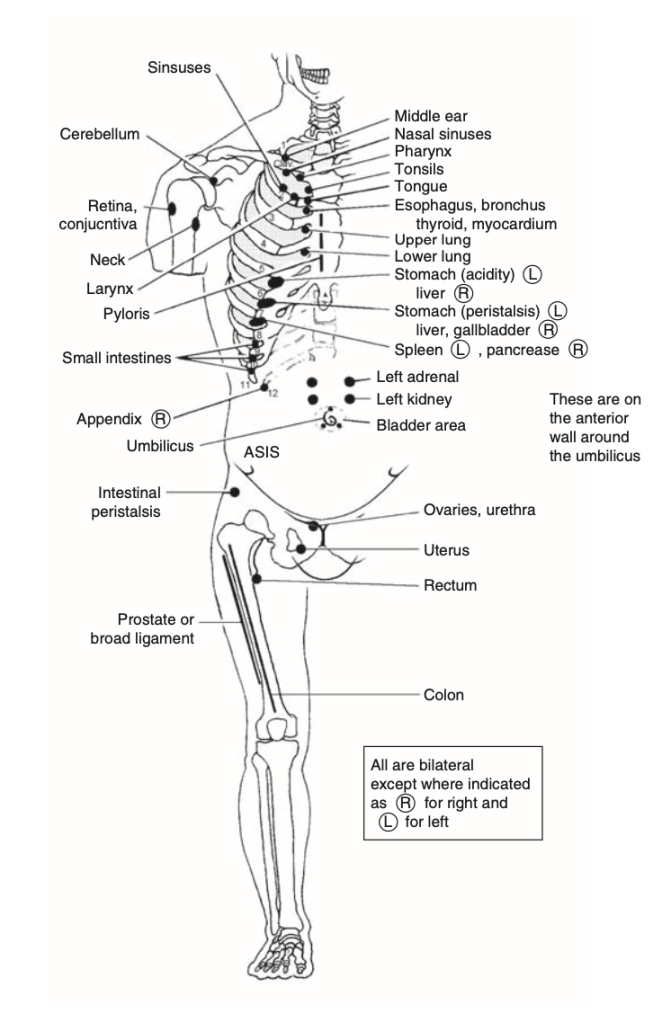
(Taken from Foundations of Osteopathic Medicine Vol.3)
A great schematic of the points and remember these points do not correlate with emergent organ failure, rather a disrupted viscerosomatic reflex, ANS dysregulation or Lymphatic stasis related to an organ.
Theoretical Mechanisms
While the exact physiological mechanisms behind Chapman’s points remain under investigation, several theories exist:
- Viscerosomatic Reflexes:
It is proposed that an internal organ dysfunction can lead to localized changes in the surrounding musculature and fascia. These changes may manifest as tender nodules at predictable sites. - Autonomic Dysregulation:
Many believe that Chapman’s points are linked to the sympathetic nervous system. An overstimulated or imbalanced sympathetic response may result in localized reflex points, serving as external markers of internal disharmony. - Lymphatic Stasis
- Chapman also said that in his theorized mechanisms that the relative change in tissue texture was due to lymphatic fluid stasis. This accumulated fluid could be vacated by direct stimulated by treatment.
Understanding these mechanisms can aid Osteopathic practitioners not only in diagnosing but also in formulating treatment strategies that address both the symptomatic point and the underlying visceral dysfunction.
Clinical Utility in Osteopathic Practice
Chapman’s points offer several practical benefits in daily osteopathic practice:
- Diagnostic Insight:
Identifying tender points can help localize the source of a patient’s complaint. For example, tenderness in a point corresponding to the liver might prompt further investigation into hepatobiliary function. - Guiding Treatment:
Once identified, these points can be targeted with specific manual techniques. The goal is to relieve the tenderness, thereby restoring balance in the autonomic pathways and indirectly supporting the associated organ system. - Monitoring Progress:
Changes in the sensitivity or texture of a Chapman’s point over time may reflect improvements or deteriorations in the corresponding organ function. This can be a useful adjunct in monitoring a patient’s progress through treatment.
By integrating these points into the broader physical examination, practitioners can adopt a more holistic approach that addresses both musculoskeletal and visceral components of health.
Research and Evidence
Research into Chapman’s points has produced mixed results, largely due to the nature of palpation and the difficulty in quantifying autonomic responses. However, some clinical studies and case reports suggest that there is a reproducible pattern of tenderness correlating with specific internal dysfunctions. Emerging evidence supports the notion that careful palpatory evaluation—when combined with other diagnostic modalities—can enhance clinical decision-making. Continued research into the neurophysiological basis of these reflexes may further validate their utility and refine their use in practice.
Integrating Chapman’s Points into a Holistic Osteopathic Model
Chapman’s points are best understood as one piece of the larger puzzle in osteopathic medicine. They complement other diagnostic and therapeutic techniques, such as structural manipulation, myofascial release, and craniosacral therapy. For the osteopathic practitioner, these points:
- Enhance the Physical Examination:
By providing tangible evidence of autonomic involvement, they allow clinicians to more accurately pinpoint areas needing further assessment. - Support Patient-Centered Care:
Patients often appreciate the tangible nature of these findings. Explaining that a specific tender point may relate to a particular internal organ can help demystify their symptoms and build trust in the treatment process. - Encourage a Mind-Body Connection:
Recognizing that physical manifestations on the skin can reflect deeper internal imbalances reinforces the osteopathic principle of treating the whole person, not just isolated symptoms.
Chapman’s points continue to occupy an important niche in osteopathic medicine. Their diagnostic and therapeutic potential lies in their ability to provide clues about internal dysfunction through careful, skilled palpation. While the exact mechanisms remain under study, the integration of Chapman’s points into routine practice enriches the osteopathic approach—blending art and science to foster holistic patient care.
As ongoing research deepens our understanding of these reflexes, osteopathic practitioners are uniquely positioned to leverage this knowledge, ensuring that every touch point becomes an opportunity for healing.
 Crux Osteopathy