Following my last post from the front of the body to the back, we find the ribs entering into a biomechanical relationship with the spine. Noting that a rib with have an articulation with the vertebrae above and below the rib. Essentially one rib with articulate with two vertebrae. Being able to differentiate between the the issue of whether or not it is a spinal mechanical issue or that of the rib is essential in clinical practice.
- Costovertebral Joints:
- Anatomy: The costovertebral joints are the articulations between the ribs (costae) and the vertebral column. Specifically, each rib has two costovertebral joints: one with the corresponding thoracic vertebra on the body of the rib and another with the transverse process of the vertebra.
- Structure: These joints are primarily synovial joints, meaning they have a joint capsule filled with synovial fluid, which provides lubrication and reduces friction during movement.
- Biomechanics: The costovertebral joints have several important functions in the thoracic spine biomechanics:
- Primary Role in Respiration: These joints allow for both bucket-handle and pump-handle motions during respiration. Bucket-handle motion involves the upward and outward movement of the ribs, increasing the lateral dimension of the thoracic cage. Pump-handle motion refers to the anterior-posterior elevation of the ribs, which increases the anterior-posterior dimension of the thoracic cage.
- Accessory Movements: These joints allow for small rotational and gliding movements that contribute to the overall flexibility and mobility of the ribcage during breathing.
- Stability: While these joints allow for movement, they also provide stability to the thoracic spine and ribcage, helping to protect the vital organs in the thoracic cavity.
- Costotransverse Joints:
- Anatomy: The costotransverse joints are the articulations between the ribs and the transverse processes of the thoracic vertebrae. Each rib articulates with the corresponding vertebra at this joint.
- Structure: Like the costovertebral joints, the costotransverse joints are also synovial joints with joint capsules and synovial fluid.
- Biomechanics: The costotransverse joints contribute to the following aspects of thoracic spine biomechanics:
- Rib Movement: These joints allow for the elevation and depression of the ribs during respiration. When the muscles associated with these joints contract, they can pull the ribs upward and outward, expanding the thoracic cage.
- Flexibility: These joints contribute to the flexibility of the ribcage, which is essential for various activities like deep breathing, coughing, and twisting of the torso.
- Stability: While allowing for movement, the costotransverse joints also contribute to the overall stability of the thoracic spine and ribcage.
Below we will look at at the movement with a little more complexity without going too deep into the
At the vertebral level one rib will articulate with two vertebrae. The inferior aspect of the superior vertebrae and the superior aspect of the inferior vertebrae, this creates the joint base which also sits upon the annulus fibrosis of the intervertebral disc.
The rib then has another articulation on the transverse process. One being the CV and CT joint. These joints allow for movement in the posterior, accommodating the respiratory movement of the thorax. The joint of the costal head is a double synovial joint.
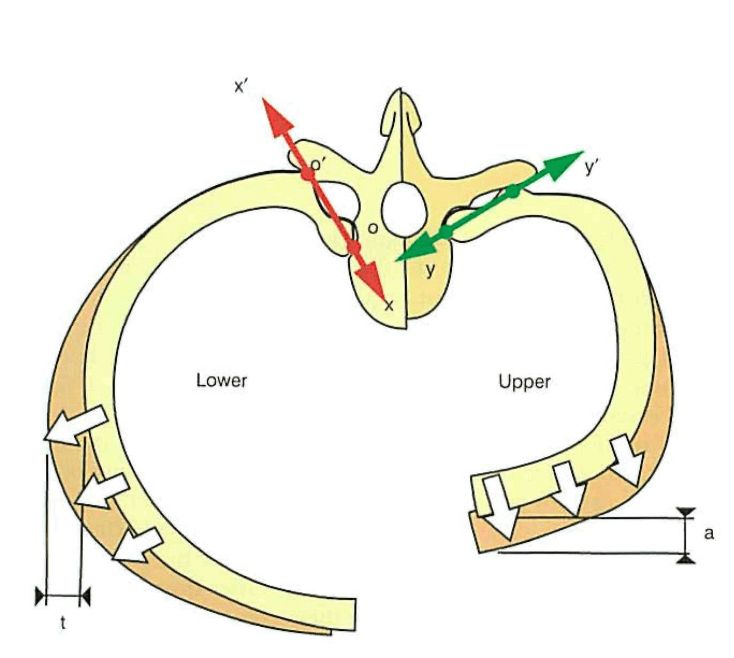
An interosseous ligament which runs from the apex of the costal head, between the two articular facets to the intervertebral disc, divides the joint and is surrounded by a single joint capsule but with two distinct joint cavities. With strong ligaments associated with it the mechanically linked joints of the CT and CV joints share on movement in the dorsal spine. Rotation about a common axis, passing through the centre of each joint. The axis of movement joining at the centre of the CT joint to the centre of the joint at the costal head acts as a swivel for the rib. This axis relative to the sagittal plane will determine the direction of movement for the rib.
For the lower ribs, the axis moves closer to the sagittal plane. The resulting movement is the rib increases its transverse diameter of the thorax. (Bucket handle movement) The axis for the upper ribs lies almost coronally. The elevation of the ribs increases in the anteroposterior diameter of the thorax. Rib elevation increases at the same time the transverse diameter of the lower thorax and the anteroposterior diameter of the upper thorax. In the mid thoracic the movement is roughly equal of transverse and anteroposterior diameters.
If you feel thoracic stiffness and haven’t been improving with conventional treatment over time, it may beneficial to get a more thorough assessment checking these joints movements and making sure movement in the thorax is balanced. If there are any questions please feel free to reach out.
 Crux Osteopathy