Here we are going to start with a basic overview of these joints and then further down we will get into a little more specifics.
- Sternochondral Joints:
- Location: Sternochondral joints are found where the ribs meet the sternum (breastbone).
- Type: These joints are typically classified as synchondrosis joints, which means they are cartilaginous joints where the connecting material is hyaline cartilage.
- Function: Sternochondral joints allow for slight movement during respiration. The flexibility of these joints is important for ribcage expansion and contraction during breathing.
- Costochondral Joints:
- Location: Costochondral joints are found where the ribs meet the costal cartilages (the cartilage portions of the ribs).
- Type: Costochondral joints are also classified as synchondrosis joints.
- Function: These joints play a role in allowing for the expansion and contraction of the ribcage during breathing. They are somewhat flexible, allowing the ribs to move and adjust during respiration.
The biomechanics of these joints are primarily related to their role in chest expansion and breathing. When you inhale, the chest cavity needs to expand to allow the lungs to fill with air. The sternochondral and costochondral joints, along with other components of the ribcage, allow for this expansion to occur.
During inhalation:
- The diaphragm contracts, moving downward and increasing the vertical dimension of the thoracic cavity.
- The external intercostal muscles contract, causing the ribs to move upward and outward.
- The sternochondral and costochondral joints allow for some flexibility, enabling the ribs to move and the ribcage to expand.
- This expansion creates a negative pressure within the chest cavity, drawing air into the lungs.
During exhalation:
- The diaphragm relaxes, moving upward and decreasing the vertical dimension of the thoracic cavity.
- The external intercostal muscles relax, allowing the ribs to move downward and inward.
- The sternochondral and costochondral joints return to their resting positions as the ribcage contracts.
The figures below describe the movement with a little more complexity with a description of the movement. Phrases used and shortened are SC (sternochondral) CC (costochondral)
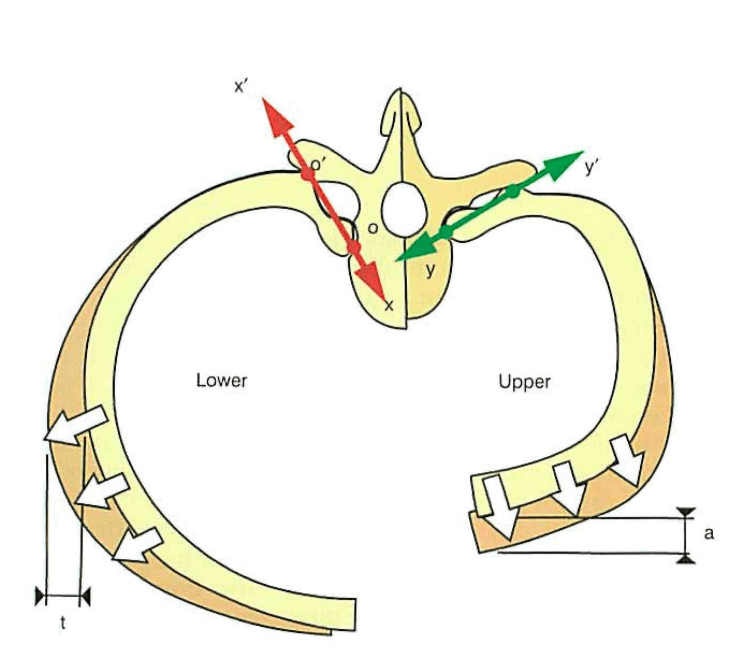
Due to the anatomy of the joint, the mechanical movement between the SC CC joints and the sternum must be harmonious. The sternum due to its mobility and articulation, its joint range will affect the angles of the ribs. Creating this bucket handle movement during inspiration of the breath. Which is more prominent in the lower ribs. (Figure 1, t)
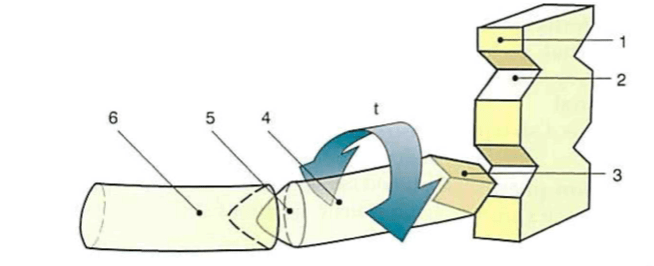
Figure 2 below shows a basic design on how the SC joint functions. The cartilage at the medial border (2) forms a wedge in the sternum and they are tightly interlocked. The Costotransverse joint (figure 1, X axis) in the dorsal spine will drive this transverse movement of the lateral ribs. The movement of the ribs as you descend the spine will change from mostly an anteromedial movement, which is the pump handle effect (figure 2, t and figure 1 y) to the more lateral movement to accommodate the lower lobe of the lung during inhalation. As for the CC joints during inspiration the costal cartilages undergo angular displacement and torsion around their long axis.
At the same time the angles of the CC and SC joints are altered. The costochondral joint is cone shaped, flattened anteroposterior and fits snugly into the anterior head end of the rib. The rib is shaped accordingly to receive it (figure 2, 5 being the cone and 6 being the rib receiving it) During inspiration the rib is lowered in relation to the sternum as the sternum rises. The costal cartilage will twist on its own axis. Behaving as a torsion rod resembling a spring that works not by torsion. (figure 2, t shows the costal cartilage and how it undergoes the torsion around an axis between the sternum and rib) The energy stored in the costal cartilage during inspiration, the muscles relax, and the elasticity will help bring the skeleton back to its position.
The body is complex and the mechanism of breathing in relation to the sternum and ribs are equally as complex. There are many variables that affect the movements of these joints and if you feel that you have issues with breathing, costochondritis, sternal pain that has been assessed by a physician book an appointment so we can assess everything in relation to those joints, or by all means contact me with any questions.
Some structures that can affect these joints
- Dysfunction in either the Costovertebral and Costotransverse joints in the dorsal spine (either from a trauma, overuse/postural deficiency)
- Compromised spinal mechanics between T1 and T10
- Muscle related dysfunction in the anterior or posterior thorax
- Fascial tension (connective tissue superfiscial and deep to these joints)
- Intercostal nerve or other nervous system issus
- Diaphragmatic dysfunction
In future posts I will go over the specific cartilage of these joints, why breathing and movement is so important to keep a healthy thorax into old age and how we can help them with manual therapy.
 Crux Osteopathy